


Solutions
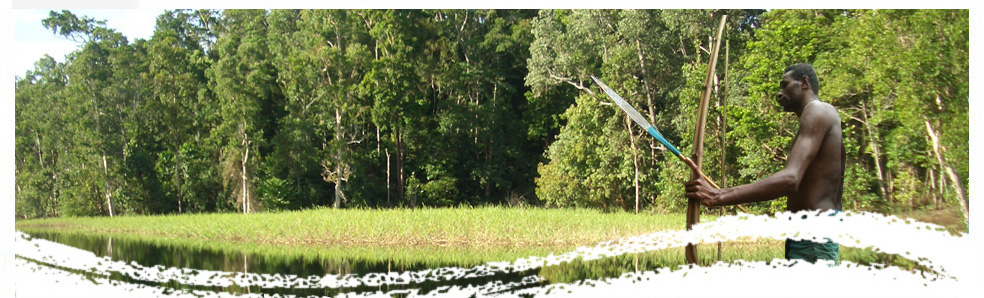
 Ancient forests are a legacy that provide us the life.
Forests are our air, water, climate. Without the forests indigenous peoples and animal species will desapperar. Without the forests, no one has a future.
The forests are under threatened by unscrupulous companies looking for woods, from landowners and farmers producing crops for the international markets.
Half of the original forests were already destroyed, and only a fifth is still intact. The technological revolution has made profitably exploitable even the most remote forests. As soon a forest is exhausted, markets move to another region, and the devastation begins again and again.
Technology is not just about destruction. It also offers a number of solutions to save the forests. We are at a crossroads. If nothing is done now, we will lose the forests forever.
Recycling 1000 kg of newspapers ...
-> saves, on average, up to 17 trees
-> saves 3 cubic meters of landfill
-> saves 31.780 liters d'acqua
-> saves, on average, up to 17 trees
-> saves 3 cubic meters of landfill
-> saves 31.780 liters d'acqua
-> Saves 31,780 liters of water
-> Produces 75% less air pollution
-> Produces 35% less water pollution.
-> Save enough energy to supply a house for 6 months
-> Consumes half (57%) than the energy used to produce one ton of paper from virgin fiber
Recycled paper is usually bleached mechanically, without need of bleaching chemicals.
Also be FSC certified recycled paper (choose the 100% recycled), but the traditional certification for recycled paper is the Blue Angel.

Buy good wood
Smart consumers
Act now!
- Details
 The International trade fair Paperworld, in Frankfurt, hosted the presentations of the Indonesian Indonesian Ecolabelling Institute (LEI). While LEI is claiming to be making a "huge commitment to sustainable papermaking in Indonesia", a broad coalition of Indonesian social and environmental NGO's released a statement condemning Asia Pulp and Paper (APP) for their unsustainable practices at PT Wirakarya Sakti (WKS), which has recently been certified by LEI as a sustainable forest plantation.
- Details
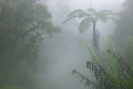
From the NGOs a vision for a new clean paper industry.
Paper consumption in Europe alone has increased six-fold since 1950. Surprisingly, paper use has increased most in the computer age although technological advancements such as electronic communication should offer easy alternatives. Some projections by industry show per capita paper consumption growing significantly in the next 10 years.
- Details
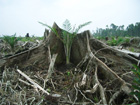 Climate policy will create both disincentives and incentives for tropical deforestation. While a REDD scheme will offer an incentive for forest conservation, climate policy in the form of a carbon tax or a cap-and-trade system will also augment the profitability of biomass plantations through an increased demand for carbon neutral energy sources. This, in turn, would raise the value of land, making preservation more difficult and emission reductions from reduced tropical deforestation more costly than currently assumed.
- Details
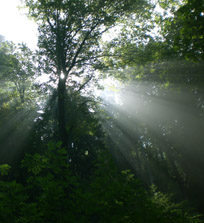 We, the undersigned, want to see a future Europe that consumes dramatically less paper than at present, with all that paper made by an industry that is less reliant on virgin tree fibres, maximises use of recycled materials, respects local peoples land rights, provides employment and has social impacts that are beneficial, conflict-free and fair. We want to see all of Europe's paper being made from responsibly- and sustainably-sourced fibres, using entirely renewable energy, with water that is as clean after paper production as before, producing zero waste and zero emissions.
In order to work towards this long-term vision, this document sets out an agenda for the transformation of the industry within the next 10 years.
- Details
 No need to eradicate or, worse, a poor cut fir to decorate our homes at Christmas. An example? One inspiring tree is that of the Gleeson Library in San Francisco, made from stacks of a bunch of their own books. A group of boys of the Gleeson Library has created this original tree simply by stacking the precise proportions of the books, taken from the shelves of the library from which are bound in green. Few stars of paper here and there, some doll and the inevitable Christmas star on top of a tree and that's environmentally friendly and no expensive. Plus, at the end of the season, the books can just be unstacked and put right back on the shelves.